
Short Answer: Aeration and overseeding is only half the job. What happens in the four weeks afterward decides whether you get a thicker lawn or an expensive disappointment. The essentials are simple and unforgiving: keep the top half inch of soil consistently moist for two to three weeks, leave the soil plugs alone, hold off mowing until the new grass reaches roughly three inches, keep foot and pet traffic off the seeded areas, and do not apply weed control until the seedlings have been mowed a few times. Most failed overseeding jobs in Southeastern Wisconsin fail on watering, not on seed.

Every September we have the same conversation with homeowners across Lake Country. The aeration went well, the seed went down, the property looked ready, and three weeks later the results are uneven. Some sections filled in beautifully. Others look like nothing happened at all.
Almost every time, the difference is aftercare. Grass seed is not a product you install. It is a living thing you start, and for the first month it has almost no tolerance for a dry afternoon. The good news is that the rules are short and the payoff for following them is large.
A grass seed has one job and one shot at it. It absorbs water, breaks dormancy, pushes out a root, and pushes up a shoot. If the seed takes on water and then dries out before that root establishes, it does not pause and wait. It dies.
Established turf is forgiving because its roots reach several inches down into soil that holds moisture for days. A three-day-old seedling has a root perhaps a quarter inch long, sitting in the layer of soil that dries out fastest. That is the entire reason aftercare watering looks so different from normal watering.
The second reason the window matters is competition. September soil is warm enough for weed seed to germinate too. Grass that establishes quickly and densely leaves no room. Grass that establishes patchily hands those gaps to whatever germinates next.
The goal is to keep the top half inch of soil consistently damp, never soaked and never dry. In practice that usually means light watering once or twice a day, for short durations, rather than the long deep sessions you use on an established lawn.
If your irrigation is on a normal schedule, that schedule is wrong for new seed. Deep, infrequent watering is exactly the right approach for mature turf and exactly the wrong approach for seedlings.
A practical test: pull back a small area and look. Dark, cool soil is right. Light, dusty soil means you are behind. Standing water or a soft, muddy surface means you are ahead and risking seed movement and disease.
Once you have visible seedlings across the seeded areas, begin extending the interval and increasing the duration. You are training the new roots to reach downward. Going from twice daily to once daily, then to every other day with a longer run, is the usual progression.
Wisconsin September weather makes this less predictable than a schedule suggests. A cool, overcast, rainy week can carry the lawn on its own. A warm dry stretch with wind can dry the surface in hours. Watch the soil, not the calendar.
The small cores of soil scattered across the lawn after aeration look untidy, and the instinct to rake them up is strong. Resist it.
Those plugs break down over one to three weeks with rain and mowing, and as they do they return soil and microbial life to the surface, help work the seed into good contact, and add a light topdressing effect. Raking them off removes free organic matter and can drag seed out of the holes where it needs to stay.
Hold the first mow until the new grass is roughly three inches tall. That usually lands somewhere around two to three weeks after seeding, but it depends on temperature and moisture, so measure rather than count days.
When you do mow, three things matter. Use a sharp blade, because a dull blade tears young plants out of loose soil rather than cutting them. Keep the deck high, taking no more than a third of the blade. And mow when the surface is dry enough that the mower does not rut or slide, which on soft, freshly aerated soil is a real risk.
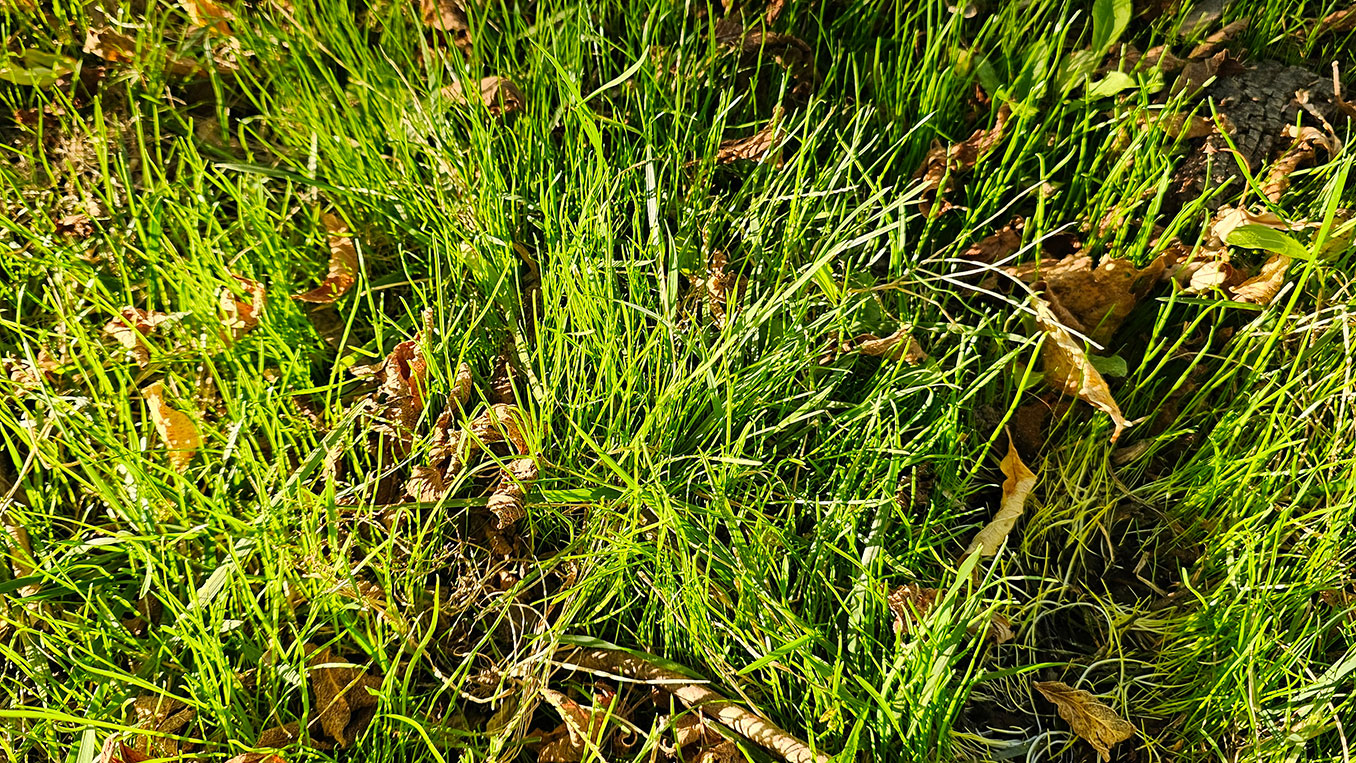
Seeded areas need about a month of light use. Foot traffic on a freshly aerated, freshly seeded surface compacts the exact soil you just opened up and crushes seedlings that have no resilience yet.
Dogs are the most common problem, and worth planning for honestly rather than hoping. If a dog uses one area of the yard, that area will not establish while the dog keeps using it. Rotating the route for a few weeks, or fencing off the worst spot temporarily, is often the difference between a repaired patch and a permanent one.
Fall leaves are the other item. A heavy leaf layer sitting on new seedlings blocks light and holds moisture against the plants in a way that invites disease. Light, frequent clearing beats one big cleanup during establishment.
Weed control is the big one. Most broadleaf products are not safe on grass that has not been mowed several times, and applying them early is a common way to kill the seedlings you just paid for. The general rule is to wait until the new grass has been mowed three or four times.
This creates an obvious tension in September, because fall is also the best window for perennial broadleaf work. The way an organic-based program resolves it is by sequencing: treat the weeds in areas that are not being seeded, seed the areas that need density, and come back to spot work once the new turf can handle it. That is a planning problem, not a product problem.
Seedlings do best in living soil rather than inert dirt. That is why we lean on compost topdressing and biological amendments at seeding time instead of a heavy synthetic starter fertilizer.
Compost improves moisture retention in the top layer, which directly reduces the risk that a dry afternoon kills a stand of seedlings. It also feeds the microbial population that makes nutrients available steadily as the new plants need them. On the clay soils common across Waukesha and Washington counties, that structural improvement is worth as much as the nutrition.
In warm September soil, most blends show first germination in seven to fourteen days, with fill-in continuing for several weeks after that. Different species in a blend germinate at different rates, so patchy early growth is normal and not a sign of failure.
Sometimes, yes. Consistent rainfall can cover the requirement entirely. The thing to watch is a gap of two or three warm dry days, which is enough to lose seedlings even after a wet week.
Focus on the seeded areas. The established turf around them can handle a normal schedule, and overwatering mature grass in fall invites disease.
That is worth diagnosing rather than reseeding blindly. Persistent thin areas usually point to a cause: heavy shade, compaction that a single aeration did not resolve, drainage, or traffic. Fixing the cause is what makes the next seeding hold.
Aeration and overseeding is the highest-return service on a Wisconsin lawn calendar, and it is also the one most dependent on the homeowner for the month that follows. Keep the surface damp, leave the plugs, mow high with a sharp blade once the new grass reaches three inches, keep traffic light, and hold the weed control. Do those five things and the lawn you see next spring will not look like the one you have now.
Have questions about caring for a freshly seeded lawn, or want it done for you?
Request a free quote at begreen.pro/get-a-quote
(262) 361-4034
Live greener. Grow better. Enjoy more.
Whether it’s your lawn, trees, shrubs, or pest issues – we’re ready to help you with Eco-friendly solutions. No matter what season.