
Short Answer: Brown patches in a September lawn have four common causes in Southeastern Wisconsin, and they look similar from a standing position. Grub damage is spongy underfoot, the turf lifts like loose carpet because the roots are gone, and you can find white C-shaped larvae in the top two inches of soil. Drought damage stays firmly rooted and greens back up with water. Disease usually shows a pattern, a ring, or a discolored edge on individual blades. Dog spots are small, sharply defined, and often ringed with darker green. The only way to confirm grubs is to cut a square foot of turf and look. Treating for grubs without doing that is how good soil biology gets wrecked for no reason.
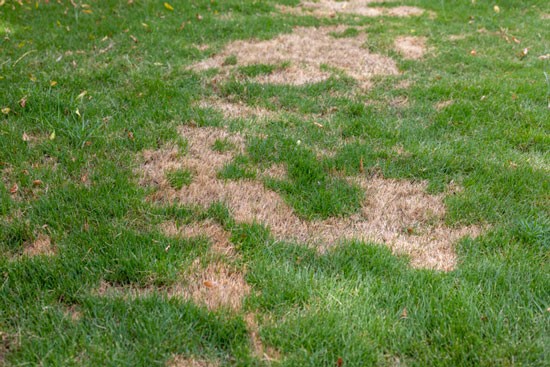
September is when the phone calls start. A homeowner walks the yard, finds brown patches that were not there in August, and reasonably assumes the worst. Nine times out of ten the question is the same: do I have grubs?
Sometimes the answer is yes. Often it is not. And the reason it matters so much is that the treatment for grubs does real work on soil life, so applying it to a lawn that is actually suffering from drought stress or dog traffic costs money, costs biology, and does not fix the problem.
Here is how we tell these four apart on a Wisconsin property, in the order we actually check them.
Before looking at color, patterns, or anything else, grab a handful of the affected turf and pull gently upward.
If the grass lifts away in a mat with little or no root resistance, you are looking at root loss, and in September in Wisconsin that means grubs until proven otherwise. Grub larvae feed on grass roots from below, so what remains on top is a green or tan blanket with nothing holding it down.
If the turf stays firmly anchored, grubs are unlikely to be the main issue no matter how bad the color looks. Roots do not survive a grub infestation and then hold on.
That single test resolves most cases in about ten seconds.
If the tug test suggests root loss, confirm it. Use a spade to cut three sides of a one-foot square about two to three inches deep and fold it back like a flap.
You are looking for white or cream-colored larvae curled into a C shape, usually with a brown head and visible legs near the front. In September they are typically somewhere between the size of a grain of rice and the size of a peanut, depending on species and how early the eggs hatched.
Count matters. A few grubs per square foot is normal in healthy Wisconsin soil and requires no action at all. A healthy, dense, deeply rooted lawn tolerates a surprising number. It is when counts get high enough that root loss outpaces root growth that you see damage, and at that point the damage is usually already visible.
Fold the flap back down, step it in, and water it. It will knit back together.
Irregular patches with no clean edges, often expanding week to week. Spongy underfoot, as though walking on a thin mattress. Turf lifts freely. Frequently accompanied by secondary damage from skunks, raccoons, or crows digging the lawn up to eat the larvae, which is often the first thing a homeowner actually notices.
Usually follows a pattern that matches the property rather than the soil: south-facing slopes, areas over buried utilities or old construction debris, strips along driveways and sidewalks that absorb heat, and any spot an irrigation head misses. Roots hold firm. The grass is often straw colored rather than tan-brown, and it responds to a week of good moisture. Much of what looks dead in a Wisconsin September is dormant, not dead.

Disease tends to announce itself with a pattern. Rings, arcs, small distinct spots of a consistent size, or lesions and discoloration on individual blades rather than uniform browning. Cool, damp September nights with warm days are ideal conditions for several turf diseases in our area. Roots stay intact, and pulling a single blade up close usually shows something on the leaf tissue itself.
Small, round or oval, sharply defined, and very often ringed by a band of unusually dark green grass where the dilute edge of the urine acted as fertilizer while the center burned. Position tells you a lot: along fence lines, near doors, or in one favored corner. Roots are typically intact and the spot does not spread.
Preventive grub control applied to every lawn every year is standard practice in a lot of the industry, and it is one of the clearest places where an organic-based program parts ways with the conventional model.
The products that reliably prevent grubs are broad in their effect. They do not distinguish between the larvae you want gone and the earthworms, beneficial insects, and soil organisms that make an organic-based lawn work. Applying that every year to a property that has never had a grub problem trades away the soil biology you have been building in exchange for insurance against a risk that was low to begin with.
The alternative is not doing nothing. It is diagnosing first, then treating what is there.
When counts justify it and damage is spreading, a targeted curative application to the affected areas stops the feeding. Applied to the areas that need it rather than the whole property, this addresses the problem without treating thousands of square feet that were never at risk.
Beneficial nematodes are microscopic organisms that parasitize grub larvae in the soil. They are living organisms, so they need careful handling, adequate soil moisture, and correct timing to work, which is where do-it-yourself attempts usually fall down. Used within a multi-year program they can meaningfully reduce grub pressure without collateral damage.
This is the long game and the most valuable part. A dense lawn with deep roots and biologically active soil absorbs grub feeding that would visibly damage a thin, shallow-rooted lawn. Aeration, overseeding, compost topdressing, and correct mowing height do more for grub resilience over three years than annual preventive spraying does.
September is fortunate timing, because grub damage becomes visible in the same month that is best for repair. Once feeding has stopped, damaged areas need seed and soil contact, which is exactly what aeration and overseeding delivers.
Areas where the turf lifted completely may need the dead mat removed, light raking to expose soil, seed, and a compost topdressing to hold moisture. Given consistent watering, those patches usually close within a few weeks in September conditions.
There is no single number that fits every lawn, because tolerance depends on turf density and root depth. A handful is normal and harmless. Counts high enough to cause visible damage are usually obvious both in the count and in the tug test.
Skunks, raccoons, and birds dig for grubs. Sudden animal digging in September is one of the more reliable indicators that grub counts are high, and it is worth checking the soil before assuming the animals are the problem.
Grubs feed until soil temperatures drop, then move deeper for winter. Early fall treatment is more effective than late fall, because larvae feeding near the surface are reachable and still doing damage. Late in the season the calculation often shifts toward repair now and management next year.
Possibly, since adult beetles fly and lay eggs where conditions suit them. Reducing what makes a lawn attractive for egg laying and building turf that tolerates feeding matters more over time than any single treatment.
Brown patches in a September Wisconsin lawn deserve two minutes of investigation before they get a product. Pull the turf. If it lifts, cut a square and count. If it holds, look at pattern, position, and the individual blades, and the cause usually becomes obvious. Treating what a lawn actually has is both cheaper and better for the soil than treating what it might have, and September gives you the ideal window to repair whatever you find.
Not sure what is causing the brown patches in your lawn?
Request a free quote at begreen.pro/get-a-quote
(262) 361-4034
Live greener. Grow better. Enjoy more.
Whether it’s your lawn, trees, shrubs, or pest issues – we’re ready to help you with Eco-friendly solutions. No matter what season.