
Short Answer: There is no flat rate for leaf cleanup, because no two Wisconsin properties drop the same amount of leaf. Cost is driven by four things: how much leaf there is, how much of the property has to be covered, how many visits the season needs, and what happens to the leaves at the end. That last one is the biggest lever most homeowners do not know they control. Mulching leaves into the lawn or redistributing them into a wooded area on the property costs less than hauling them away, because hauling is an additional charge. The honest way to get a real number is to have the property looked at, and the honest way to lower it is to choose the disposal method that fits your yard.
Leaf cleanup is one of the services we get the most pricing questions about, and it is also one of the hardest to answer with a single figure. A quarter-acre lot in Waukesha with two young maples and a half-acre lot in Oconomowoc under mature oaks are not the same job, even though they are both described as fall cleanup.
What we can do is be completely clear about what drives the number, so you can see where your property is likely to land and where you have real control. Here is how leaf cleanup is actually priced across Southeastern Wisconsin.
Before talking about cost, it helps to be precise about scope, because "leaf cleanup" means different things to different companies.
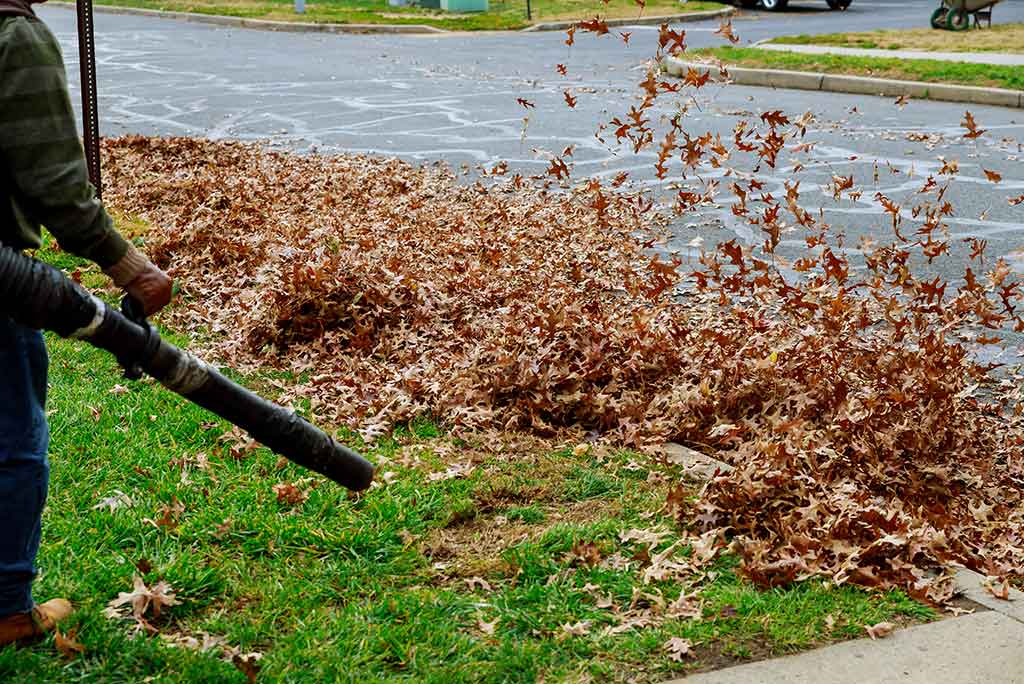
Our fall yard cleanup means blowing and piling leaves across the property, and clearing branches, twigs, and other debris that accumulated over the season. It is a whole-yard service, not just the open lawn: beds, along fence lines, around the foundation, and the awkward corners where leaf collects and mats.
Then there is the question of where the leaves end up, and that is a separate decision with a real cost difference. We offer three options: mulch them into your lawn, redistribute them into a natural wooded area on the property, or remove them from the site for an additional charge.
This is the dominant factor, and it has almost nothing to do with lot size. A small property surrounded by mature trees can produce more leaf than a large open lot with a few young ones.
What matters is canopy: how many mature trees are on and around the property, what species they are, and how much of their drop lands on your ground rather than the neighbor's. Species matters more than people expect, because oak leaves are heavier, tougher, and slower to break down than maple or ash, which affects both the labor and the disposal options.
Area still counts, because every square foot has to be covered. Beyond that, access and terrain change the labor considerably. Flat, open ground with a wide gate is fast. Slopes, tight side yards, extensive beds to work around carefully, retaining walls, and fenced sections that equipment cannot reach all add time.
Wisconsin trees do not drop on one schedule. Ash and maple often finish well before oaks are done, and a hard wind can move a season's worth of leaf onto your lawn in an afternoon.
Some properties are genuinely one-visit properties. Others need two or three passes across the season to avoid a wet mat sitting on the turf for weeks. A single late cleanup on a heavy-canopy property is usually the more expensive choice in the end, because it means dealing with a compacted, wet, matted layer instead of a loose one, and because the lawn underneath pays for the delay.
This is the factor most homeowners have the most control over and think about the least.
Mulching leaves back into the lawn is the least expensive option, and on properties with moderate leaf volume it is also the best thing you can do for your soil. Shredded leaf feeds soil biology and adds organic matter to the clay soils common across our service area.
Redistributing leaves into a natural wooded area on the property is the middle option for lots that have somewhere appropriate to put them. The leaf stays on site, breaks down where it does no harm, and there is no hauling.
Removing leaves from the property is an additional charge, because it means containing, loading, transporting, and disposing of significant volume. It is the right answer for properties that genuinely produce more leaf than the site can absorb, and it is worth paying for when that is the case. It is simply not the right answer for every property, which is why we ask rather than assume.

Leaf cleanup is easy to think of as a cosmetic service, and it is not. The reason we push on timing is that leaf left sitting on turf does measurable damage.
A wet leaf mat blocks light, traps moisture against the crowns of the grass plants, and creates ideal conditions for snow mold to develop under snow cover. Lawns that go into a Wisconsin winter under a matted layer come out of it thinner, patchier, and slower to green up, which turns into spring repair work that costs more than the cleanup would have.
There is also the compounding piece. If you have just invested in September aeration and overseeding, leaf cover is the fastest way to lose that investment. New seedlings cannot push through a leaf layer, and they have no reserves to wait it out.
The only accurate leaf cleanup quote is one based on your actual property. What we look at is the canopy, the total area to be covered, access and terrain, the condition of the beds and edges, and whether the site has anywhere appropriate to redistribute leaf.
Two questions are worth thinking about before that conversation, because they change the recommendation. First, how much of the leaf could reasonably be mulched into the lawn, given the volume and species. Second, is there a wooded or natural area on the property where leaf can go. Answering those honestly usually moves the number more than anything else on the estimate.
Not always, and often not. A single late cleanup on a heavy-canopy property means handling a wet, compacted mat, which takes longer than the same volume handled loose. It also means the lawn spent weeks under cover. On light-canopy properties, one visit is genuinely enough.
Yes, and on many properties that is the recommendation regardless of price, because mulched leaf feeds the soil. The limit is volume: past a certain amount, mulching stops working and starts smothering.
The service covers the property, including blowing and piling from beds and edges, and clearing branches, twigs, and other debris. Those areas are usually where leaf mats worst and where hand work is required.
It depends on your trees. The practical target is having the lawn clear of matted leaf before the first lasting snow, with earlier passes as needed to keep the turf from sitting under cover for weeks. Getting on the schedule early in the season is what makes correct timing possible, because late fall books up quickly.
Leaf cleanup is priced by the work the property actually requires, and the four levers are volume, area and access, number of visits, and disposal method. The one you control most is the last one, and the answer that is cheapest is often also the best thing for your soil. What you are buying is not just a tidy yard in November. It is a lawn that comes out of a Wisconsin winter in the shape it went in.
Want a real leaf cleanup quote based on your property and your trees?
Request a free quote at begreen.pro/get-a-quote
(262) 361-4034
Live greener. Grow better. Enjoy more.
Whether it’s your lawn, trees, shrubs, or pest issues – we’re ready to help you with Eco-friendly solutions. No matter what season.