
Short Answer: If it is late September or October and you did not get your lawn seeded, you have two real options and one bad one. The good options are late-season seeding while there is still enough warm soil for germination, or dormant seeding, where you deliberately put seed down late enough that it will not germinate until spring and let Wisconsin winter do the soil-contact work for you. The bad option is waiting for spring, because spring seeding competes with summer heat and with crabgrass prevention timing. Dormant seeding is the underused answer for anyone who missed the fall window, and on heavy clay it often outperforms a spring attempt.
Every year we talk to homeowners in late September and October who know they should have seeded and did not. The reasons are ordinary. Travel, a busy month, a contractor who did not call back, or simply not realizing how narrow the good window is.
The instinct is to write off the year and plan for spring. That is usually the wrong instinct, and understanding why comes down to what seed actually needs and what a Wisconsin winter does to soil.
Grass seed germinates based on soil temperature, not air temperature or the date. In Southeastern Wisconsin, the practical window for seeding that will germinate and establish before winter runs from mid-August through roughly the third week of September, with some flexibility in a warm year.
Past that, two things go wrong. Germination slows down as soil cools, and even seed that does sprout may not develop enough root mass to survive winter. A seedling that germinates in mid-October has a few weeks of marginal growing conditions before the ground freezes, which is often not enough.
The honest assessment is site specific. A south-facing lawn in a warm October can push the window later than a shaded north-facing lawn in a cold one. This is one of the reasons we look at the property rather than working from a calendar.
If there is still warm soil and a reasonable forecast, late-season seeding can work, with adjusted expectations.
What changes is the blend and the plan. Faster-germinating species carry more of the load, because they can get up and rooted quicker. Compost topdressing matters more, because it holds surface moisture and moderates soil temperature at exactly the layer where a late seedling is trying to survive. And the results are usually a partial stand in fall that fills in during spring rather than a finished lawn in November.
Watering discipline gets harder and more important in this window. October in Wisconsin can be wet or it can be dry and windy, and a dry windy week on late seed is unforgiving.
Dormant seeding is the option most homeowners have never heard of, and it is genuinely useful in our climate.
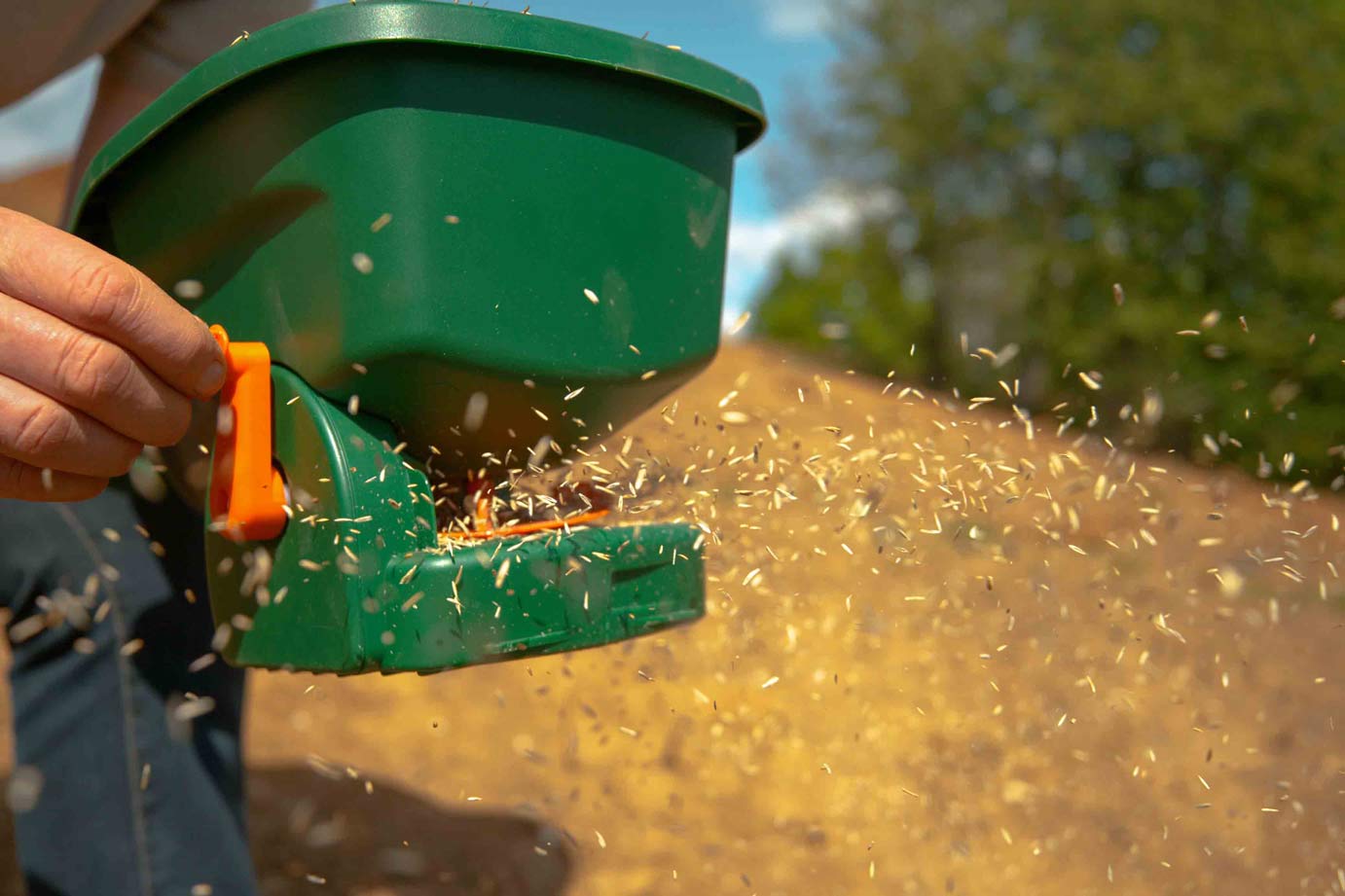
The idea is to put seed down late enough in the season that soil temperatures are already too cold for germination, typically late November into December in our area, and sometimes onto light snow cover or frozen ground. The seed sits dormant through winter. Then, as soil warms in spring, it germinates weeks earlier than anything you could physically seed at that point, because it is already in place and already in contact with soil.
The mechanism that makes dormant seeding work is the freeze-thaw cycle. Wisconsin soil expands and contracts repeatedly through winter, opening and closing small cracks at the surface. That movement works seed down into genuine soil contact, which is the same thing aeration holes accomplish in September and the single biggest factor in germination success.
On the heavy clay soils common across Waukesha, Washington, and Ozaukee counties, that freeze-thaw action does work that is difficult to replicate mechanically in spring.
It is strongest for repairing specific problems: thin areas, dog spots, patches damaged by grubs or disease, bare strips along driveways, and areas that got missed. It is a repair and improvement tool more than a whole-lawn renovation tool.
It is also the right answer for anyone who wants earlier spring green-up in repaired areas, because dormant seed germinates on the soil's schedule rather than waiting for the ground to be workable.
Dormant seeding has lower and less predictable germination rates than a well-timed September seeding. Some seed is lost to birds, some to water movement, and some to a winter that behaves unusually. Nobody should choose dormant seeding over a September window if the September window is available.
It also does not fix causes. Seed on compacted, shaded, or poorly drained ground will fail in spring the same way it would fail in fall. Where the underlying issue is compaction or drainage, that has to be addressed regardless of when the seed goes down.

Spring feels like the natural time to seed, and it is the hardest.
Three things work against it. New seedlings started in April or May have only a few weeks of good conditions before summer heat arrives, and shallow-rooted young grass is the first thing to fail in a July stretch. Spring is also peak germination season for crabgrass and other annual weeds, so the new grass competes for the same open ground. And the standard spring crabgrass pre-emergent, which stops weed seed from germinating, stops grass seed from germinating too, forcing a choice between weed prevention and seeding.
Fall seeding sidesteps all three. That is why the whole industry pushes fall, and why dormant seeding is a better fallback than spring for anyone who missed it.
If it is still September, seed now. Nothing else in this article beats using the window you still have.
If it is early to mid October, an assessment is worth having. Depending on soil temperature, the specific areas involved, and the forecast, late-season seeding may still be viable, particularly with compost topdressing to protect the surface.
If it is late October or November, plan dormant seeding. Use the remaining fall for the work that does not depend on germination: aeration to relieve compaction, a fall feeding, perennial broadleaf weed treatment, leaf management, and the final low cut. Then put seed down when the soil is cold, and let winter do the rest.
Both late-season and dormant seeding lean on soil rather than on inputs, which is why they fit this approach well.
Compost topdressing does the heavy lifting in both cases. It holds moisture at the surface where seed needs it, moderates temperature swings, feeds the microbial life that will support the seedlings, and improves clay structure so roots can actually go somewhere. On a dormant seeding, a light compost layer also helps hold seed in place through winter water movement.
None of that is a product substituting for timing. It is soil work making imperfect timing usable, which is a fair description of most of what an organic-based program does.
After soil temperatures have dropped below the germination threshold and stayed there, which in Southeastern Wisconsin generally means late November into December. Seeding too early risks germination followed by winter kill, which is the worst of both outcomes.
Aeration is best done earlier in fall while the soil is workable and the grass can heal. If aeration happened in September or October, the openings and the freeze-thaw cycle work together well for a later dormant seeding.
No, not through winter. Snowmelt and spring moisture handle it. Watering becomes relevant once germination begins in spring, and that is when attention matters again.
Light snow cover is generally acceptable and can even help you see coverage as you spread. Deep snow is a problem, because seed sitting on top of it moves with the melt instead of settling into soil.
Missing the September window is a setback, not a lost year. If soil is still warm, seed now with a blend and a plan suited to the date. If it is too late for that, wait for cold soil and dormant seed, then let Wisconsin winter press that seed into contact for you. Either path is a better bet than a spring seeding fighting heat, crabgrass, and its own pre-emergent.
Not sure whether your lawn is still in the seeding window?
Request a free quote at begreen.pro/get-a-quote
(262) 361-4034
Live greener. Grow better. Enjoy more.
Whether it’s your lawn, trees, shrubs, or pest issues – we’re ready to help you with Eco-friendly solutions. No matter what season.